How to pour a latte art rosetta
The rosetta is the fern-like pattern with many thin leaves. It looks hard, but it is one continuous pour with a small side-to-side wiggle. If you can pour a heart, you can learn it.
How a rosetta works
Each leaf of a rosetta comes from the wiggle: you rock the pitcher from side to side while milk flows. The white foam spreads out in a zigzag, and because the cup is tilted and the crema moves forwards, the zigzag folds into curved leaves. While you wiggle, you move the pitcher slowly back towards you. At the end, a thin pull-through cuts the leaves in the middle and creates the stem.
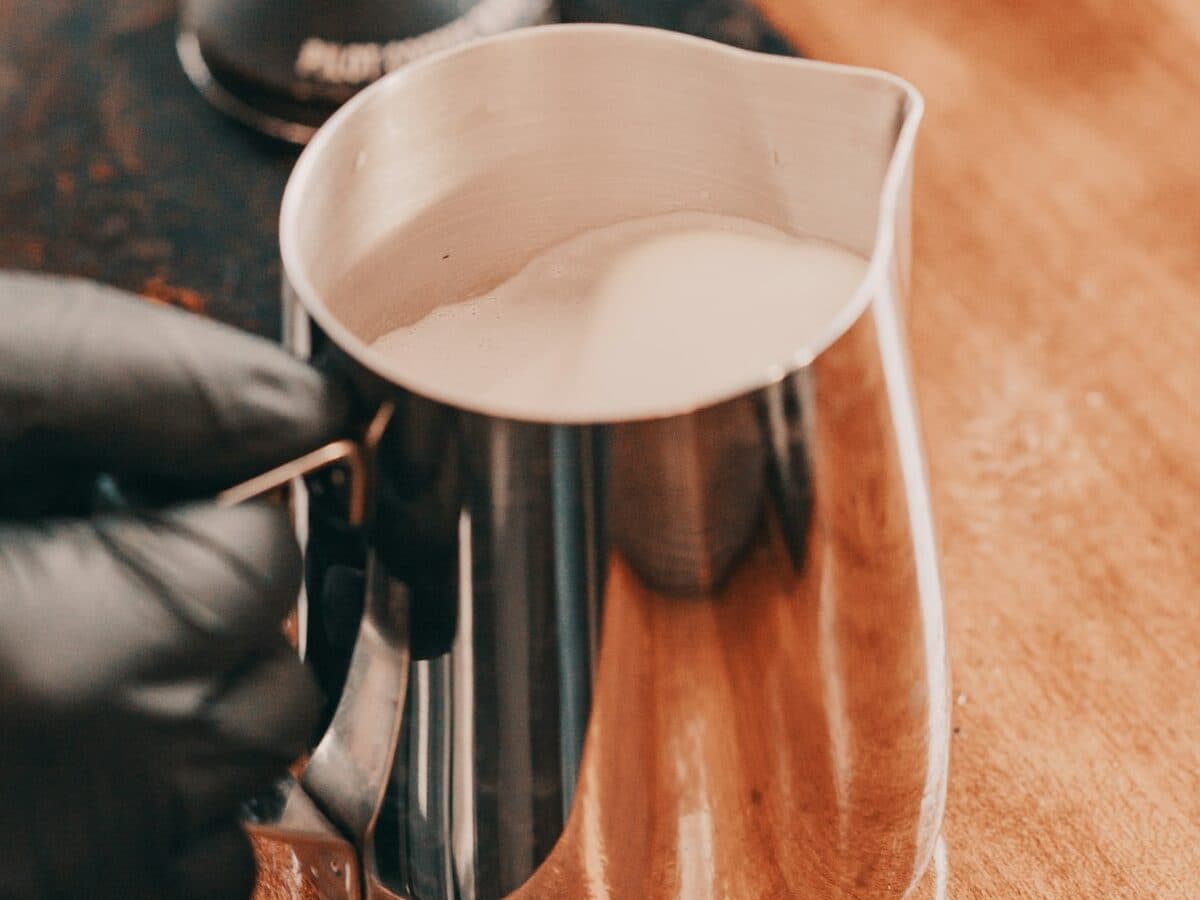
The milk needs to be thinner than for a heart: glossy and quick to flow, with little foam. Thick milk makes fat, blurry leaves. If you are unsure, check how to steam milk for latte art.
Before you pour
- Milk: steam a little less air in than for a heart. It should be glossy and run quickly off the spout.
- Cup: a wide cup gives the leaves room to spread. A narrow, tall cup makes a short rosetta with few leaves.
- Grip: hold the pitcher loosely by the handle, so the wrist can move freely. A tight grip turns the wiggle into an arm movement.
- Practice: swirl water in a pitcher and rehearse the wiggle and the slow move back a few times before the real cup.
Pouring a rosetta step by step
- Tilt the cup towards you a little more than for a heart and pour the base from a few centimetres up into the centre until the cup is about half full.
- Bring the spout down onto the surface in the centre of the cup, or slightly beyond it, and pour with a steady flow until white appears.
- Start the wiggle: rock the pitcher left and right with your wrist only, a small, even movement of about 1 cm. Keep the flow constant.
- While you wiggle, move the pitcher slowly back towards you. The leaves appear in front of the spout and grow towards the far side.
- Level the cup gradually as it fills, so the leaves have room to spread.
- When you reach the edge closest to you, stop wiggling, lift the pitcher a little and thin the stream.
- Pull through in one straight line along the middle of the leaves to the far edge.
Practise the wiggle with an empty pitcher first. It should come from the wrist, like turning a key, not from the arm.
Common mistakes
Only a zigzag line, no leaves
Why
The spout is too high or the flow too weak, so too little foam reaches the surface.
Fix
Keep the spout close to the surface and pour a little faster while you wiggle.
Fat, blurry leaves
Why
The milk is too thick, or the wiggle is too wide.
Fix
Steam less air into the milk and make the wiggle smaller and quicker.
A short rosetta with few leaves
Why
You move back too fast, so the pitcher reaches your edge of the cup before the leaves can build up.
Fix
Move back more slowly and let the leaves form in front of the spout. Start further towards the far side if you run out of room.
Crooked or uneven sides
Why
The wiggle swings further to one side, or the whole arm moves.
Fix
Keep the elbow still and rock only the wrist. Look at the centre line, not at the leaves.
The pull-through drags the leaves
Why
The pitcher is too low and the stream too thick during the pull-through.
Fix
Lift the pitcher and thin the stream first, then pull through quickly in a straight line, the same as for the heart.
Where to go from here
Once your rosettas are symmetrical, try more and thinner leaves by making the wiggle smaller and faster. If the leaves keep merging, go back to the tulip for a while: it trains the same control over flow and height.
Frequently asked questions
Why don’t my rosetta leaves show?
Usually the spout is too high or the flow is too weak during the wiggle. Bring the spout close to the surface and keep the flow steady and a little faster.
Should I wiggle with the wrist or the arm?
With the wrist. A small, even rocking motion makes thin, symmetrical leaves. Moving the arm makes the wiggle too wide and uneven.
Where do I start the rosetta in the cup?
In the centre or slightly beyond it, depending on how many leaves you want. You then move back towards yourself, so the rosetta grows over the whole cup.
How many leaves should a rosetta have?
There is no fixed number. At the start, aim for leaves that are clearly separated and even on both sides. More, thinner leaves come with a smaller, faster wiggle.